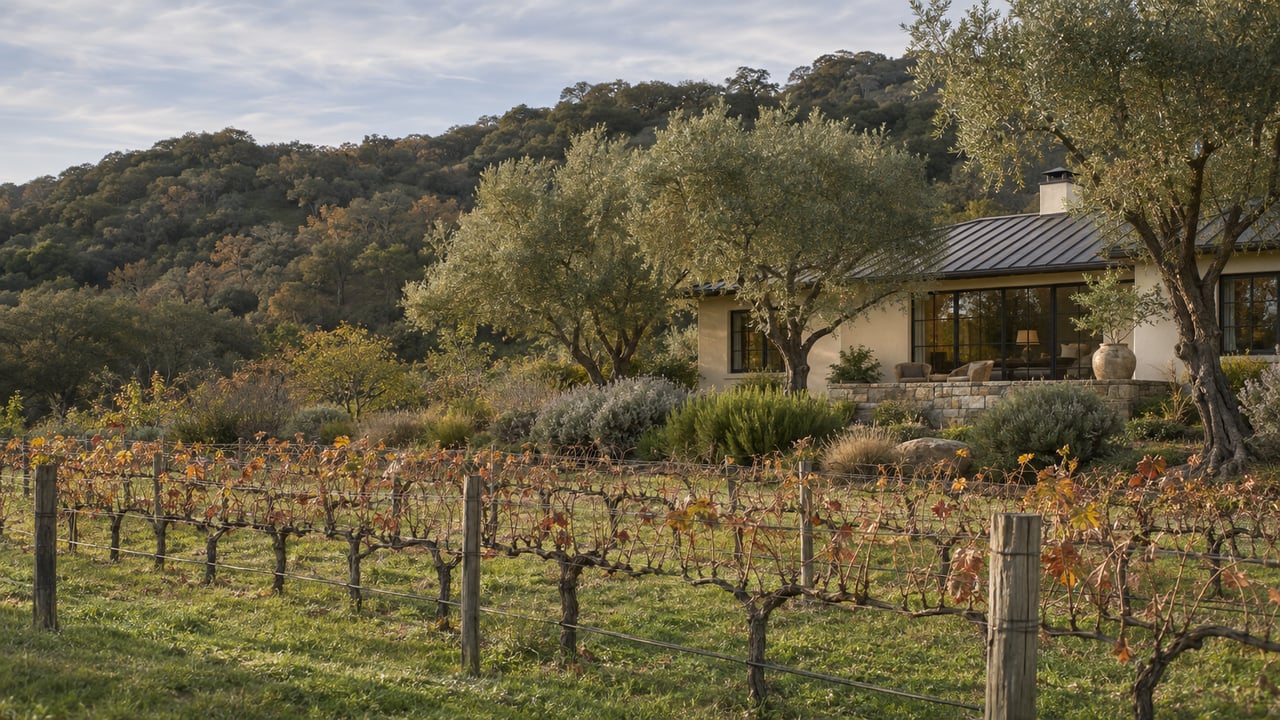
From Oct. 1, 2025, to Aug. 1, 2026, Napa growers removed 2,944 acres of vineyard, about 7% of standing acreage, according to Napa Valley Grapegrowers' mapping project. Statewide the figure was 11%, which makes Napa's share smaller, but it still adds up to a lot of land coming out of production in a single year. A buyer comparing a bungalow near downtown Napa with a house outside St. Helena will reasonably ask whether the same pressure is reaching homes.
So far the pressure is landing on wine property first. Among Napa homes, it shows most in how long the largest ones take to sell. Houses in the City of Napa are trading more slowly than a year ago, but the county's own records officer reports no rise in requests from homeowners to lower their assessments. A Napa buyer should first decide how close to the wine economy the house sits, and only then which town it is in.
Where the wine numbers are actually moving
The numbers are clearest on the growing side. Napa County's 2025 winegrape crop was worth $968.7 million, down 6% from the year before, and the average price per ton fell 4.5% to $6,690, according to the county's crop report posted July 28, 2026. Demand downstream is soft as well. At an industry symposium in Napa this month, presenters reported U.S. distributor-to-retailer wine volume down 6.7% for the three months through September, The Press Democrat reported.
Asking prices for wine property have followed. Benessere Vineyards, a 42-acre winery estate at 1010 Big Tree Road in St. Helena, was listed at $35 million in November 2024 and relisted at $28 million in February 2025. In June 2026 it drew a winning auction bid of $9 million, with a reported pending total of $10.15 million once the auction fee was added, according to The Press Democrat. In May, an appraiser told the same paper that Napa's top tier of Cabernet vineyards was holding up better than the rest, while about a third of the bottom tier was struggling.
The county assessor has made the same distinction. Asked about requests for lower assessments, Napa County Assessor-Recorder John Tuteur told Napa Valley Features: "I would say the increase is greater among commercial, vineyard and winery properties and that residential properties are at the same level as prior years." When owners believe their property has lost value, they ask the assessor to lower it, and those requests are rising for winery and vineyard property while staying flat for homes.
The county numbers point in two directions
The California Association of Realtors put Napa County's median existing single-family sale price at $918,000 in September 2026, up 2.0% from September 2025, while sales fell 16.0% over the same year. The same C.A.R. September report put the county's unsold inventory at 8.5 months, up from 7.4 months a year earlier. Median time on market was 69 days, down from 114 in September 2025.
Napa Valley Features' November 5 analysis reported a different number. By its count, the county's median asking price for September fell 10% from a year earlier to $1,272,500. Fewer listings went into contract than in any September since at least 2019, and the largest estates sold only after deep price cuts. The same analysis reported that county transfer-tax receipts for 2026 had already passed the total for all of 2025.
The two reports measure different things. C.A.R.'s figure is the price homes sold for, and Napa Valley Features measured the price sellers were asking. Both countywide numbers also change with the mix of homes that trade. When several St. Helena estates close in the same month, the county's sale-price figures go up even if fewer homes sold overall.
Town by town, September and October
The Bay Area Real Estate Information Services MLS, or BAREIS, publishes closed sales by area each month. The table compares residential sales in September and October 2026 with the same two months of 2025.
| BAREIS area | Sales, Sept.–Oct. 2025 | Sales, Sept.–Oct. 2026 | Average days on market, Oct. 2026 |
|---|---|---|---|
| Napa | 137 | 114 | 91 |
| American Canyon | 13 | 27 | 44 |
| St. Helena | 13 | 16 | 140 |
| Yountville | 6 | 5 | 30 |
| Calistoga | 8 | 2 | No sales |
| Angwin | 2 | 1 | No sales |
Most of the county's home sales happen in the Napa area, and its count fell about 17% across those two months. Prices there have not dropped in step. The average sale was $1,003,302 in September 2026 and $1,583,273 in October 2026, compared with $1,270,149 and $1,352,197 in the same months of 2025. Those are averages over a few dozen sales, so one large closing can move them. They show a market with fewer sales, not one selling at markdowns. Over the summer the Napa area recorded 64 residential sales in July and 79 in August, which matches a market losing sales gradually rather than all at once.
St. Helena is where the estate market shows up in the figures. In October 2026 the area closed 12 residential sales totaling $32,447,696, an average of $2,703,975 per sale, and those homes averaged 140 days on the market. That is twice as many sales as St. Helena had in October 2025, so the high-end market is still closing deals. Those deals take longer, and Napa Valley Features reported that the largest estates needed deep price cuts before they sold.
Across the four up-valley areas combined, St. Helena, Yountville, Calistoga and Angwin, sales fell from 29 in September and October 2025 to 24 this year. The samples are small enough that one estate can shift a town's month. Over the two months, though, the up-valley areas closed fewer sales and took longer to sell than the Napa area did.
American Canyon, at the south end of the county, moved the other way. Its sales roughly doubled across the two months, and its October homes averaged $668,620 and 44 days on market, the shortest time to sell of any area with more than one sale that month. Of the county's housing markets, American Canyon is the furthest from vineyard economics, and this fall it had the fastest sales.
Land took the hardest hit
The same BAREIS reports also track lots and acreage. In October 2026 the Napa area recorded four lot sales averaging $893,000, and those parcels averaged 202 days on market, more than twice as long as the area's homes. Land prices depend most directly on what a parcel can earn from grapes. Ranked by days on market in the Napa area, land takes longest, then the larger homes, and in-town houses sell fastest. The Benessere auction is the most extreme recent example of the same pattern.
What this means for the house you're weighing
For a buyer, the practical effect depends on which of these markets the house belongs to.
If the house is in the City of Napa, you are in the market with the most sales. Fewer homes are changing hands than a year ago and they are taking longer to sell, but nothing in the assessor's comments or the average prices suggests owners are under pressure. Sellers there have had less reason to take steep discounts than estate owners up the valley. The months ahead may bring even fewer choices. Countywide, BAREIS counted 134 listings in October 2026, the fewest of any month this year, against 205 in September. A buyer hoping for winter bargains in town may mostly find fewer homes to choose from. Our earlier look at how downtown Napa rearranged itself this fall covers what has changed within walking distance of many of these houses.
If the house sits on acreage, near vines, or up-valley above the county's typical price, you are in a different market. St. Helena's October sales averaged more than four months on the market, owners of wine property are asking for lower assessments, and estates have sold after large reductions. A buyer at that level has more time and room to negotiate than the county median suggests. The next Napa County crop report will not come out until next year, so the 2026 harvest has not yet shown up in the official figures.
Whatever the town, the property's own history is more useful than any county figure. Before making an offer, look at how long the house has been listed, when the price was cut and by how much, and which nearby sales were land and which were houses. On the up-valley side of the county those details often matter more than the asking price.
Questions buyers are asking about Napa this fall
Is the City of Napa cheaper now because of the wine downturn?
Not on the evidence through October. Napa-area average sale prices in September and October 2026 stayed near last year's levels, and sales fell by about 17% over those two months. The county assessor reports that residential requests for lower assessments are at prior-year levels.
Are up-valley homes still selling?
Yes. St. Helena closed 12 residential sales in October 2026, up from six in October 2025, and those sales averaged 140 days on market.
Which Napa County figure should a buyer watch this winter?
Watch the monthly listing count. It fell to 134 in October, the fewest of 2026, and whether it rises again in January will show whether winter in the City of Napa brings more choices or fewer.
If you are choosing between a home in town and one closer to the vines, it helps to look at the sales history of the specific houses you're considering, including how long each was listed and what it sold for. More on the valley is on our Napa neighborhood page, and you can reach Regina Gaspari directly to talk it through. Let's Connect.