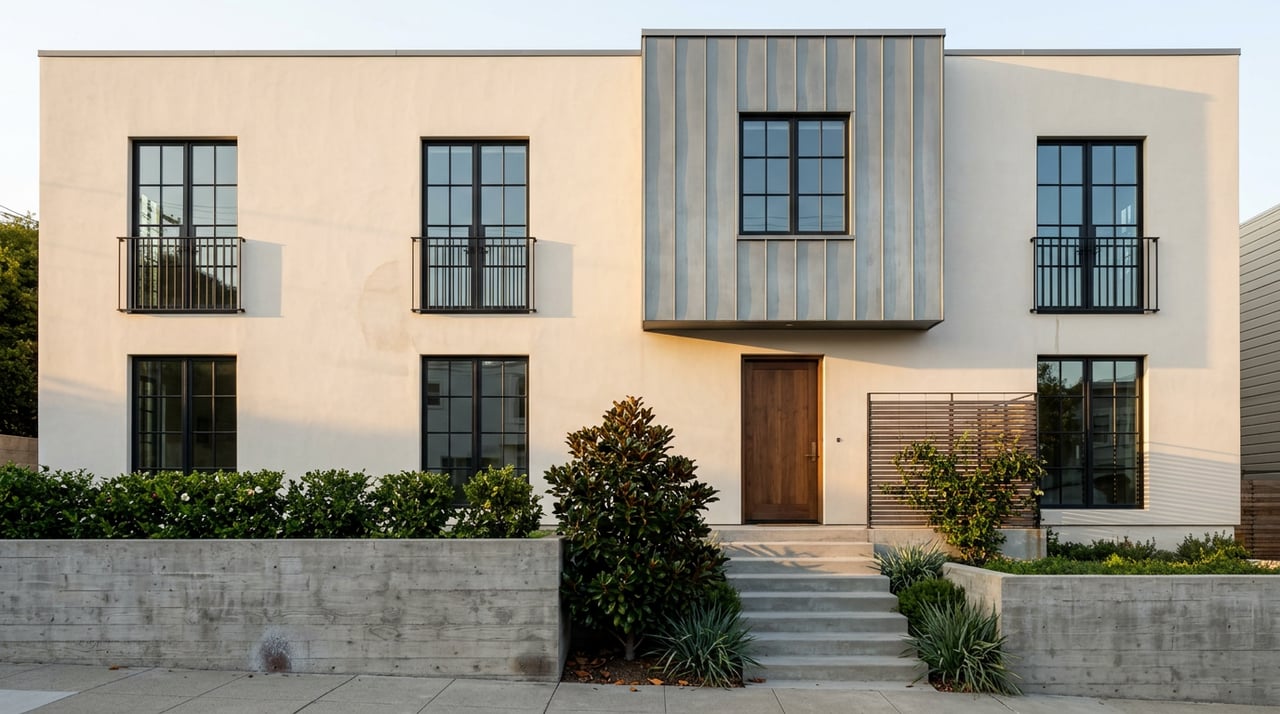
The San Francisco Standard reported that in May 2026, a six-bedroom house on Union Street in Cow Hollow sold for $15 million against an asking price of $7.95 million. That's 88.68 percent over ask, the largest percentage overbid on a San Francisco home priced above $5 million in 26 years. The buyer was a Los Angeles-based LLC.
That same season, a mile and a half east in South Beach, condo sellers were watching median prices slip more than 10 percent year over year, even as sales volume in the neighborhood climbed. Two properties, two directions, one city.
If you've been reading San Francisco market updates this summer, you've seen the headline number: the median single-family home price hit $2.05 million in July 2026, up 25.2 percent from a year earlier. That's the kind of stat that gets repeated everywhere, and it's accurate. It's also the wrong number to plan around unless you happen to be shopping in exactly the segment that's producing it.
The Median Is Blending Two Different Markets
San Francisco right now is not one housing market moving in one direction. It's two markets, pulling apart, reported as a single figure.
At the top, large, move-in-ready, well-located single-family homes are being bid up by buyers who have real money and very little patience. The San Francisco Standard reported that Compass data showed 44 San Francisco homes sold for at least $1 million over asking in June 2026 alone. Across the first half of the year, 144 homes closed that far above list price, compared with just 8 during the same period in 2025.
Agents covering the ultra-luxury end have started calling this the "mansion shortage." The San Francisco Standard quoted Sotheby's agent Annie Williams, describing the scramble around a $56 million Pacific Heights-area sale in April 2026: "there really is a housing crisis at the upper end, a mansion shortage." The property in question, at 2898 Vallejo Street, closed April 7 in an off-market deal and topped anything the city had seen in years.
Two months later, two more Presidio Heights homes traded for a combined $32 million in a single week. One of them, at 3501 Jackson Street, sold for $21 million, roughly double what its owner had paid for it in 2007.
Meanwhile, condos, the segment most first-time and move-up buyers actually shop in, are behaving like a different market entirely.
What July 2026 Looked Like, Side by Side
| Single-Family Homes | Condos | |
|---|---|---|
| Median sale price (July 2026) | $2.05 million | $1.25 million |
| Year-over-year change | +25.2% | +13.6% |
| Month-over-month change | -4.7% | +3.1% |
| Active listings (end of July 2026) | 156 | 417 |
| Year-over-year inventory change | -40.9% | -42.5% |
Both segments are tight on supply. But look at the direction of travel. Single-family prices pulled back slightly from June to July, the kind of seasonal cooling this market sees most years, layered on top of an extraordinary annual gain. Condos moved the opposite way that month, climbing even as the broader narrative said the market was catching its breath.
Price per square foot tells the same story from a different angle. Single-family homes reached $1,181 per square foot in July 2026, up nearly 20 percent from a year earlier. In Pacific Heights and Presidio Heights specifically, homes have been trading closer to $5,000 per square foot, a figure that has almost nothing to do with what a condo buyer in the Sunset or a townhouse buyer in Bernal Heights is actually paying.
Why the Top of the Market Is Moving Differently
Two forces are doing most of the work here, and neither one is about San Francisco housing supply in general.
The first is genuine scarcity of a specific product: large, renovated, well-sited homes with views, in the handful of blocks where those homes exist at all. You can't build more Broadway. Sotheby's agent Joseph Lucier, discussing the Vallejo Street sale, noted that most owners renovating homes at that level are doing it for themselves, not to flip, which means the same handful of trophy properties rarely reappear on the market once someone buys and improves one.
The second is a wave of AI-driven wealth and anticipated IPO liquidity moving through the city. Compass agent Michael Bellings, who represents buyers in this segment, described the mood around expected public offerings from companies like OpenAI, Anthropic and Databricks as pushing buyers toward urgency rather than caution. That's a specific, temporary catalyst, and it's landing hardest on the property type that's already scarce: big, finished, single-family homes.
None of that changes what a two-bedroom condo in the Marina is worth, or what a light-filled flat in Noe Valley will fetch. Those are separate conversations with separate buyer pools.
Where the Calmer Story Is Actually Playing Out
The condo market's story in mid-2026 isn't simple either, but it's a different kind of complicated. Citywide, condo inventory has tightened sharply, down 42.5 percent year over year by the end of July, which is squeezing buyers who had been treating condos as the more approachable way into the city. That window is narrowing.
At the same time, pockets with heavier new construction are still working through it. South Beach, the city's busiest condo market by volume with 315 closed sales in June 2026 and 348 more pending, saw its median price slip more than 10 percent year over year that same month. New supply in South Beach and Mission Bay keeps pricing there more competitive than the rest of the condo market, even as everything sells faster than it used to.
That's useful information if your budget puts you in that range. It means the citywide "condos are recovering" headline and the "South Beach prices are soft" reality can both be true at once, depending on which few blocks you're actually looking at.
The Relief That's Coming, and Why It Won't Touch This Year
In December 2025, San Francisco's Board of Supervisors adopted the Family Zoning Plan, which allows taller and denser buildings across roughly 60 percent of the city, concentrated in northern and western neighborhoods along transit corridors. It was a response to a state mandate requiring the city to plan for more than 82,000 new homes by 2031.
It's a real structural shift, the first meaningful upzoning of those neighborhoods since 1978. But the city's own chief economist estimated the plan would produce less than half of the roughly 36,000 units it was designed to enable in those rezoned areas, according to San Francisco Chronicle reporting at the time of adoption. Zoning changes don't build homes. Permits, financing and construction do, and that process takes years, not months.
If you're deciding whether to buy now or wait for the zoning change to cool prices, the honest answer is that it isn't going to move the needle on this year's inventory, or next year's.
What This Actually Means for Your Search
The number that matters is not San Francisco's median. It's the median for the specific product type and neighborhood you're competing in.
- If you're shopping for a large single-family home in an established, view-oriented neighborhood, expect the fastest-moving, most competitive segment of the entire city. Financing needs to be ready before you tour, not after you fall in love with something.
- If you're a condo buyer, you're watching a market that's tightening on supply overall but still varies block by block. A softer read in one submarket doesn't mean the rest of the condo market is following it.
- If you're selling anything that qualifies as large, renovated and well-located, this is a genuinely strong window. If you're selling a condo, pricing and presentation still matter more than the headline would suggest, because buyers in that segment have more to choose from than the luxury story implies.
A Few Questions Worth Asking Directly
Does the mansion shortage mean condos are a weak investment right now? No. It means condos are a separate market with their own supply and pricing dynamics. Some condo submarkets, like South Beach, are actually softer on price even while selling briskly. That's a different situation than luxury single-family homes, not a worse one.
Will the Family Zoning Plan bring prices down soon? Not in the near term. The plan changes what can legally be built. It doesn't fund or construct anything on its own, and the city's own economic estimates suggest it will fall well short of its unit targets even once projects start moving.
Understanding which market you're actually in, not the one the headlines describe, is the difference between a strategy and a guess. That's the kind of read Regina Gaspari walks San Francisco buyers and sellers through before a single offer gets written. If you're trying to figure out where your search or your listing actually sits in this market, let's connect.
This article is general information, not legal, tax or financial advice. Consult a qualified professional about your situation.